Roblox Safety Settings: Essential Tips for Newcomers
Effectively managing Roblox safety settings is crucial for newcomers to ensure a secure and enjoyable experience, empowering parents and players with essential tools for digital protection and responsible engagement within the platform.
Are you new to the vibrant world of Roblox and wondering how to keep your experience safe and secure? Understanding Roblox Safety Settings: Essential Tips for Newcomers is paramount for both young players and their parents, ensuring a positive and protected journey from the very first login.
Understanding the Roblox ecosystem: a brief overview for parents
Roblox is more than just a game; it’s a massive online platform where millions of users create, share, and play millions of unique games and experiences developed by other users. For newcomers, especially parents, grasping the scale and nature of this ecosystem is the first step towards ensuring a safe environment. It’s a creative hub, a social space, and an entertainment platform all rolled into one, offering unparalleled opportunities for imaginative play and connection.
However, with great freedom comes great responsibility, and the open nature of Roblox means that users can encounter a wide range of content and interactions. This diversity is what makes Roblox so appealing, but it also necessitates a proactive approach to safety. Knowing how the platform operates, what kind of content is available, and how interactions typically occur will empower you to make informed decisions about your child’s online activities.
What makes Roblox unique?
Roblox stands out due to its user-generated content model. Unlike traditional video games with pre-defined narratives, Roblox is a toolkit for creativity. Users, from seasoned developers to young enthusiasts, design everything from intricate role-playing games to simple obstacle courses. This means the content is constantly evolving, offering endless novelty but also a varying degree of quality and appropriateness. Understanding this dynamic is key to appreciating why robust safety settings are so vital.
- User-Generated Content: Millions of games and experiences created by players themselves.
- Social Interaction: Chat, private messages, and group features allow extensive communication.
- Virtual Economy: Robux, the in-game currency, is used for purchases and trading.
- Cross-Platform Play: Accessible on PC, mobile, Xbox, and VR devices.
Ultimately, a comprehensive understanding of the Roblox ecosystem allows parents to move beyond basic parental controls and engage with their children about their online experiences. It fosters a collaborative approach to digital safety, where open communication complements the technical safeguards in place. This foundational knowledge is the bedrock upon which all other safety measures are built, ensuring that the platform remains a source of joy and learning rather than concern.
Setting up a new Roblox account: initial safety considerations
When creating a new Roblox account, especially for a child, the initial setup phase is a critical opportunity to establish strong safety foundations. This goes beyond simply choosing a username and password; it involves making deliberate choices that directly impact the account’s security and the user’s online experience. Taking the time to configure these settings correctly from the outset can prevent potential issues down the line and provide peace of mind.
The first step is always to use an accurate birthdate for the account. This is not merely a formality; Roblox uses the birthdate to automatically apply age-appropriate safety settings, often restricting chat and certain content for younger users. Misrepresenting this information can inadvertently expose a child to features or interactions that are not suitable for their age. Always double-check this detail before finalizing the account creation.
Choosing a safe username and strong password
A username that doesn’t reveal any personal information is crucial. Avoid using real names, locations, or any identifiable details. Encourage creative, anonymous usernames that are fun but private. Similarly, a strong, unique password is your first line of defense against unauthorized access. Combine uppercase and lowercase letters, numbers, and symbols, and ensure it’s not a password used for other online services.
- Username Best Practices: Avoid real names, age, or location.
- Password Security: Use a combination of characters, numbers, and symbols.
- Email Verification: Link a parent’s email to the account for recovery and notifications.
- Two-Step Verification (2SV): Enable 2SV immediately for an extra layer of security.
Beyond these immediate steps, it’s also advisable to discuss these initial safety measures with your child. Explaining why these choices are important helps them understand the value of online privacy and security. This collaborative approach not only secures their account but also educates them on responsible digital citizenship from the very beginning. The initial setup is more than just technical configuration; it’s an educational moment.
Navigating privacy settings: controlling communication and interaction
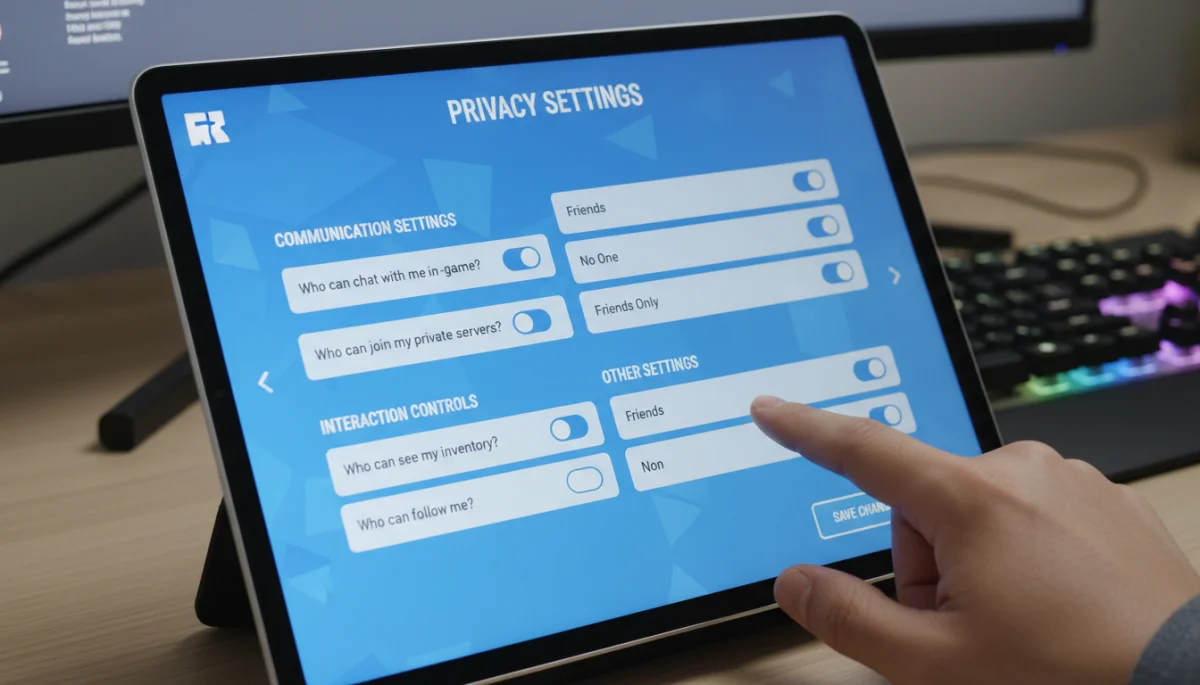
Roblox’s privacy settings are the cornerstone of a safe online experience, offering granular control over who can interact with a user and how. For newcomers, understanding and correctly configuring these settings is essential to tailor the experience to individual needs and comfort levels. These controls allow users to manage everything from who can chat with them to who can send them private messages, providing a vital shield against unwanted interactions.
The platform offers various levels of communication restrictions, from allowing chat with everyone to limiting it to friends or even turning it off entirely. For younger children, setting the chat to ‘No one’ or ‘Friends’ is often the safest option, minimizing exposure to potentially inappropriate conversations. As children grow and demonstrate digital maturity, these settings can be adjusted, always with ongoing discussion and supervision.
Customizing communication preferences
Within the privacy settings, users can specify who can chat with them in-game, who can send messages, and who can follow them into experiences. These options are highly customizable, allowing for a personalized safety profile. It’s important to review these settings regularly, as the user’s needs and the online landscape can change over time.
- Chat Filtering: Roblox automatically filters inappropriate language, but custom settings add more control.
- Who Can Message Me: Options include ‘Everyone’, ‘Friends’, or ‘No one’.
- Who Can Invite Me to Private Servers: Control who can initiate private game sessions.
- Who Can See My Inventory: Decide if other players can view your virtual items.
Beyond the technical configurations, it’s crucial to foster an environment where children feel comfortable discussing any uncomfortable online interactions. Even with the best privacy settings, unforeseen situations can arise. Encouraging open dialogue about online experiences, both positive and negative, empowers children to seek help and allows parents to intervene when necessary. The privacy settings are a tool, but open communication is the ultimate safeguard.
Parental controls and account restrictions: empowering guardians
Roblox offers robust parental control features designed to give guardians significant power over their child’s account settings and activity. These controls are invaluable for newcomers, providing a structured framework to manage screen time, spending, and content access. Activating and understanding these features is a non-negotiable step for any parent aiming to ensure a secure and balanced Roblox experience for their child.
The ‘Account Restrictions’ feature, in particular, is a powerful tool. When enabled, it limits the child to a curated list of experiences deemed appropriate by Roblox, effectively blocking access to games with older age ratings or user-generated content that might be unsuitable. This setting acts as a digital gatekeeper, ensuring that younger users primarily engage with content that aligns with their developmental stage.
Utilizing parental PIN and spending limits
A Parental PIN is a four-digit code that, when set, locks various account settings, preventing children from changing them without parental permission. This is crucial for maintaining the integrity of the safety configurations you’ve established. Additionally, parents can set spending limits on Robux purchases, preventing unauthorized transactions and teaching financial responsibility within the digital realm.
- Parental PIN: Secure settings changes, purchases, and account access.
- Age Restrictions: Automatically filters content based on the child’s age.
- Spending Limits: Control Robux purchases to manage virtual currency spending.
- Activity Monitoring: Review past purchases, chat logs (where available), and friend requests.
By leveraging these parental controls, guardians can create a tailored and safe environment that evolves with their child’s age and maturity. Regular review and adjustment of these settings, coupled with ongoing conversations about online safety, form a comprehensive strategy. These tools aren’t just about restriction; they’re about empowering parents to guide their children through the digital landscape responsibly.
Reporting and blocking: essential tools for user safety
Even with the most stringent safety settings in place, encountering inappropriate content or behavior is a possibility in any online environment. For newcomers, knowing how to effectively use Roblox’s reporting and blocking features is an essential skill. These tools empower users to take immediate action against undesirable interactions, contributing to a safer community for everyone.
The ‘Report Abuse’ feature allows users to flag content or behavior that violates Roblox’s Community Standards. This includes inappropriate chat, offensive creations, harassment, or any other conduct that makes a user feel uncomfortable or unsafe. Reports are reviewed by Roblox’s moderation team, leading to potential action against the offending user or content. It’s crucial to teach children how and when to use this feature responsibly.
How to report and block effectively
Reporting is straightforward: users can typically find a ‘Report’ button within the game interface or on a user’s profile. When reporting, it’s helpful to provide as much detail as possible about the incident. Blocking, on the other hand, immediately prevents a specific user from interacting with you, sending messages, or following you into games, providing instant relief from unwanted attention.
- Locate Report Button: Usually found near user profiles or in-game menus.
- Provide Details: Explain what happened, when, and where.
- Blocking Immediate Effect: Stops all communication and interaction from the blocked user.
- Teach Discretion: Educate children on when to block versus when to report.
Empowering users, especially children, with the knowledge of how and when to report and block is a critical component of digital literacy. It teaches them to advocate for their own safety and contribute positively to the online community. These features are not just reactive measures; they are proactive tools that, when used correctly, help maintain the integrity and safety of the Roblox platform for all players.
Educating children on online etiquette and risks
While technical safety settings are vital, the most powerful tool for ensuring a child’s safety on Roblox, and indeed any online platform, is education. For newcomers, this means having open, ongoing conversations about online etiquette, potential risks, and responsible digital behavior. Equipping children with this knowledge empowers them to make smart choices and navigate the digital world with confidence and caution.
Start by discussing the concept of ‘stranger danger’ in an online context. Explain that not everyone online is who they say they are, and personal information should never be shared with anyone, regardless of how friendly they seem. Reinforce the idea that personal details, such as real names, addresses, school names, or phone numbers, are private and should remain so. This fundamental lesson is the bedrock of online safety.
Key topics for discussion
Beyond personal information, talk about appropriate online communication. Teach children to be kind and respectful, just as they would in face-to-face interactions. Discuss cyberbullying and how to respond if they encounter it, emphasizing that they should always tell a trusted adult. Explain the permanence of online content and how once something is shared, it can be difficult to remove.
- Personal Information: Never share real name, address, school, or phone number.
- Online Strangers: Treat unknown online contacts with caution.
- Cyberbullying: Report and block, and always tell a trusted adult.
- Digital Footprint: Understand that online actions can have lasting consequences.
- Financial Awareness: Discuss in-game purchases and the value of real money.
Ultimately, ongoing education fosters a sense of responsibility and critical thinking in children. It’s not about instilling fear but about building resilience and awareness. Regularly revisiting these topics, adapting discussions as children grow and their online activities evolve, creates a dynamic safety net that complements all technical safeguards. An informed child is a safer child, equipped to navigate the complexities of the digital age.
Advanced safety measures and continuous monitoring
For parents and newcomers, establishing initial safety settings is a fantastic start, but true online safety on Roblox requires a commitment to advanced measures and continuous monitoring. The digital landscape is ever-evolving, and what was safe yesterday might not be sufficient tomorrow. Proactive engagement and regular review of settings and activities are key to maintaining a secure and enjoyable environment.
One advanced measure is enabling account notifications for purchases or significant account changes. This ensures that parents are immediately aware of any activity that might deviate from established norms. Many parents also find it beneficial to periodically play Roblox with their children or to simply observe their gameplay. This direct engagement provides invaluable insights into the types of experiences they are accessing and the interactions they are having.
Regular review and adaptation
Technology changes, and so do children’s needs and online habits. Regularly review all Roblox safety settings, including privacy controls, parental PINs, and content restrictions. As children mature, some settings might be loosened, while others might need to be reinforced depending on their behavior and encountered situations. This iterative process ensures that safety measures remain relevant and effective.
- Account Notifications: Stay informed about purchases and critical account changes.
- Co-play and Observation: Understand your child’s in-game activities firsthand.
- Update Awareness: Stay informed about new Roblox features and safety updates.
- Open Dialogue: Maintain continuous conversations about online experiences.
Continuous monitoring isn’t about surveillance; it’s about active parenting in the digital age. It’s about being present, informed, and ready to adapt. By combining robust technical settings with ongoing education, open communication, and regular review, parents can create a truly secure and enriching Roblox experience for their children, fostering both creativity and responsible digital citizenship.
| Key Safety Area | Brief Description |
|---|---|
| Account Setup | Use accurate birthdate, strong password, and enable 2SV for foundational security. |
| Privacy Settings | Control communication, messaging, and interaction with other players to limit exposure. |
| Parental Controls | Set a Parental PIN, manage spending limits, and restrict access to age-inappropriate content. |
| Education & Monitoring | Educate children on online risks and continuously monitor activity for ongoing safety. |
Frequently asked questions about Roblox safety
The most important settings for a new Roblox account include setting an accurate birthdate, enabling a Parental PIN, configuring privacy settings to limit chat and interactions, and activating Two-Step Verification (2SV). These foundational steps provide robust protection from the outset, ensuring a safer experience for younger users and giving parents control over account access and communication.
To prevent unauthorized purchases, utilize the Parental PIN feature within Roblox settings. This PIN can lock various account functions, including Robux purchases. Additionally, link a parent’s email to the account for purchase notifications and consider setting spending limits or using gift cards for controlled spending, teaching financial responsibility in the virtual economy.
If your child encounters inappropriate content or behavior on Roblox, immediately teach them to use the ‘Report Abuse’ feature and block the offending user. Reinforce the importance of telling a trusted adult about such incidents. Review privacy settings to ensure they are appropriate and discuss the situation calmly with your child to understand what happened and how to avoid similar encounters.
Yes, you can restrict the games your child plays on Roblox using the ‘Account Restrictions’ feature, accessible through the Parental PIN. This setting limits your child’s access to a curated list of experiences deemed appropriate by Roblox for their age group. This ensures they primarily engage with content suitable for their developmental stage, filtering out potentially inappropriate user-generated content.
It is recommended to review your child’s Roblox safety settings regularly, ideally every few months or whenever there are significant platform updates. As children grow and their online habits evolve, their needs for protection may change. Frequent review ensures that settings remain appropriate and effective, adapting to new challenges and maintaining a secure online environment.
Conclusion
Embarking on the Roblox journey as a newcomer, whether as a player or a parent, opens up a world of creativity and social interaction. However, navigating this expansive digital landscape safely requires a proactive and informed approach. By diligently applying the Roblox Safety Settings: Essential Tips for Newcomers discussed, from initial account setup to ongoing monitoring and education, you can create a secure and enriching environment for all users. The combination of robust technical controls, open communication, and continuous vigilance forms the strongest defense against potential online risks. Empowering users with the knowledge and tools to manage their digital presence responsibly ensures that Roblox remains a positive and engaging platform for everyone.
